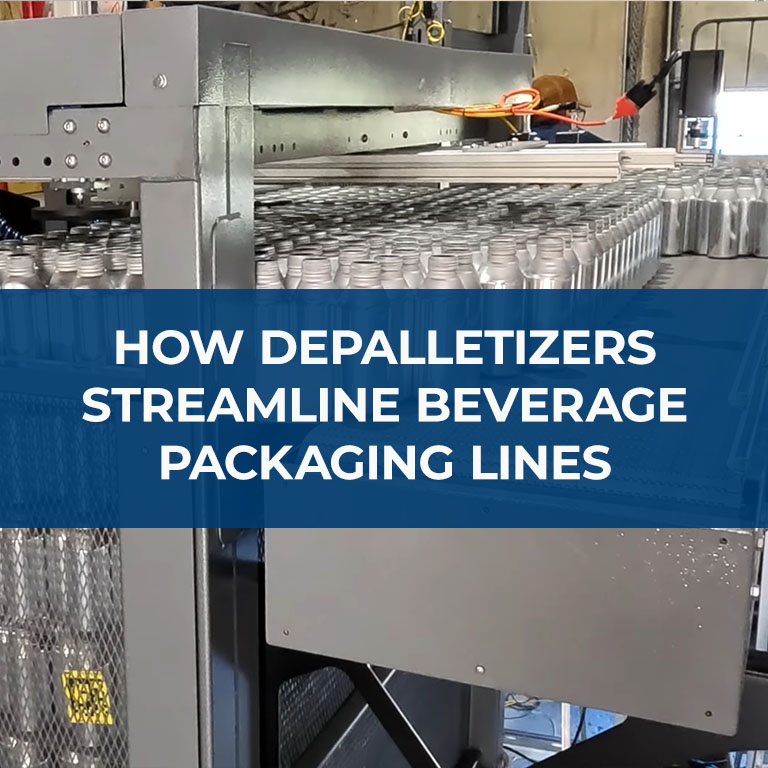

Many beverage and consumer packaged goods manufacturers experience delays in getting their products off pallets and onto lines fast enough to maintain throughput.
Hand unloading packages in a packaging line can slow operations, create safety risks and limit how quickly lines can run. Workers spend hours lifting cases, bottles, cans or bags, which strains their bodies and introduces potential errors that disrupt downstream processes.
An automated depalletizer machine solves this by transforming a labor-intensive unloading process into a smooth, continuous operation that keeps pace with filling, packaging and shipping.
What Are Depalletizers?
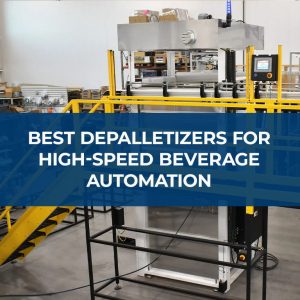
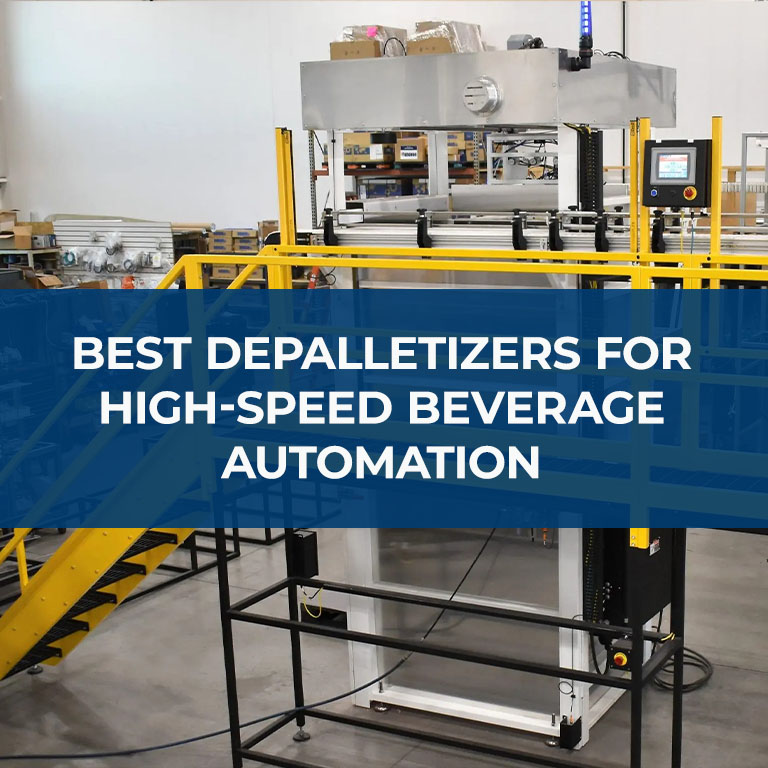
Depalletizers are automated machines that unload products or containers from pallets and transfer them onto a conveyor or production lines for further processing.
Instead of workers manually lifting and placing items, the depalletizer uses mechanical systems — robotic arms, vacuum grippers or layer-handling devices — to remove products quickly and consistently.
This automation can increase throughput, optimize labor by reducing workplace injuries and ensure a steady flow of materials into downstream operations, such as filling, capping, labeling or case packing.
What Is the Difference Between a Palletizer and a Depalletizer?
A palletizer organizes finished products into stable pallet loads for storage or shipment. A depalletizer removes containers from the pallets at the start of production, ensuring the line receives a steady supply.
| Function | Palletizer | Depalletizer |
| Primary purpose | Builds and stacks product into a pallet load | Unloads containers from a pallet at the start of production |
| Location | End of line | Beginning of the line |
| Material flow direction | Outbound product for storage or shipping | Inbound empty containers for filling or processing |
| Main action | Forms layers and creates stable unit loads | Removes layers and feeds containers into downstream equipment |
| Why do the beverage and CPG industries use it? | To prepare finished goods for transport | To maintain a steady container supply for production |
How a Depalletizer Works
Depalletizers use coordinated mechanical control, sensor feedback and guided motion sequences to feed containers into downstream equipment. The operation requires five distinct steps.
- Step 1: The operator or infeed system delivers a full pallet into the machine, while the infeed conveyor positions the pallet square to the lift carriage. Sensors confirm alignment to prevent rotation that could cause sweeping issues later.
- Step 2: The machine lifts the pallet to the correct height through a controlled indexing sequence. Side containment rails maintain load stability and prevent outward bowing or drift as the stack rises.
- Step 3: A sweep mechanism or robotic arm gently pushes the top layer of containers onto a discharge conveyor using defined acceleration curves and tooling designed for specific formats.
- Step 4: The removal system lifts the tier sheet cleanly without dragging containers. Vacuum frames apply uniform suction across the sheet, while mechanical clamps secure a corner or edge to prevent the next layer from moving.
- Step 5: The process repeats until the pallet is empty. When the base pallet clears the frame, it moves to an exit conveyor for stacking or removal.
Components of a Depalletizer
Depalletizers rely on structured mechanical systems that manage vertical motion, horizontal transfer, alignment and safety.
- Pallet infeed conveyor: Entry system with photoeyes, stops and alignment guides for pallet positioning.
- Hoist pallet and lift: Chain drive or screw mechanism with containment rails for vertical travel.
- Sweep assembly or gripper: Guided carriage with sweep bars or robotic tooling matched to container geometry.
- Tier sheet remover: Vacuum frame or clamp system for separator sheet extraction.
- Discharge conveyor: A transfer system featuring metering belts or lanes for seamless downstream integration.
- Empty pallet stacker: Collection system that builds stable columns for forklift access.
- Controls and HMI: Interface for recipe management, alarms and safety interlock monitoring.
Types of Depalletizers
Depalletizers offer different automation levels and handle various heights, which affects throughput and functional capability.
Automatic, Semi-Automatic and Manual
Depalletizers fall into three categories, each of which is specific to the degree of automation required for the production environment.
- Automatic units manage lifting, sweeping and sheet removal with minimal operator input. They support continuous high-speed lines and remove manual touch points that slow productions.
- Semi-automatic units require operators for specific tasks such as sheet removal or pallet entry, but still manage the primary unloading process.
- Manual unitsrely on guided operator interaction and are suitable for plants with lower throughput or frequent batch changes.

Full-Height vs. Half-Height Depalletizers
The difference between half-height and full-height depalletizers depends on the pallet height capacity, vertical lift range and space requirements.
Full-height systems support tall pallets and work well for high-volume operations that need a continuous supply. Half-height palletizers work with shorter pallets, fit smaller rooms with limited ceiling clearances and can help speed up batch-based production.
Depalletizer Machine Types
Each depalletizer type differs in how it grips and transfers products off the pallet. The best fit depends on your container format, handling sensitivity and throughput needs.
The four types are as follows.
- Robotic palletizers have articulated arms programmed with predefined pick paths and often feature tooling options, including vacuum plates, magnetic heads or mechanical fingers. These systems excel in operations with varying container formats or fragile components. Integration often includes vision systems for layer recognition and misalignment correction.
- Vacuum depalletizers use suction plates specifically designed for smooth surfaces, such as glass bottles and jars, cans and some plastics. Vacuum flow control and cup pattern layout enable stable lifting and prevent accidental drops.
- Clamp-style depalletizers use side-gripping mechanisms to lift containers, including boxes, drums or large rigid formats. Clamp geometry and pressure control protect the container walls while maintaining a firm lateral grip.
- Layer depalletizers remove entire layers at once via containment frames that stabilize the load during transfer. These machines support high throughput and integrate well into operation with large batch sizes.
What Industries Benefit Best From Depalletizers?
Depalletizers are valuable anywhere production depends on a steady, safe and predictable stream of containers into the line. These sectors help reduce the reliance on manual labor by automating pallet unloading.
- Beverage production: Breweries, coffee canning lanes, cocktail producers and bottlers use depalletizers to continuously supply fillers, rinses and labelers, prevent line starvation, improve equipment effectiveness and reduce breakage from rushed manual handling.
- Food and CPG: Canned food, pet food and other CPG manufacturers rely on depalletizers to deliver uniform container spacing and gentle, repeatable handling. That can mean fewer dents, tears or seal issues, simpler downstream automation and faster, more reliable throughput.
- Household goods: Producers of items like detergents, personal care products, paper goods and home-cleaning supplies benefit from depalletizers that can handle bulky, high-volume packaging. Consistent placement reduces worker fatigue and maintains speed on high-output lines without damaging lightweight or flexible containers.
- Fulfillment centers and distribution hubs: High-volume warehouses use depalletizers to quickly break down inbound pallets. Products can then move directly into sorting, storage or picking systems for faster receiving, smoother inventory flow and less dependence on manual upload teams during peak demand.
- Co-packers: Co-packing facilities need to switch between container types and brands rapidly. Depalletizers give them the flexibility to handle varied formats with quick changeovers, while maintaining stable infeed rates across multiple client products.
- Other industries — pharmaceuticals, chemicals, oils: These operations often handle regulated, sensitive or spill-prone containers. Depalletizers provide controlled uploading that protects product integrity, supports compliance and minimizes operator exposure to heavy loads or hazardous materials.
Find a Quality Depalletizer With Ska Fabricating
Ska Fab offers durable and reliable depalletizer solutions that address these challenges through full-height, half-height, automatic and semi-automatic models suited for various container formats. Browse our range of depalletizers or contact us to discuss a tailored solution that meets your specific needs.